

Key Takeaways
- Ontario’s announcement applies to provincial government operations, not consumer drone ownership.
- The policy focuses on cybersecurity, procurement, and security-sensitive operations.
- DJI remains deeply integrated across Canadian commercial and public safety drone operations.
- Canadian experts acknowledge both DJI’s technical leadership and the challenges of building domestic alternatives.
- Long-term investment and industrial support would be required for Canada to compete at scale.
Ontario’s Drone Announcement
Ontario’s recent announcement restricts the use of Chinese-made drones across provincial government operations. Consequently, it has generated significant discussion throughout the Canadian drone industry. Some headlines and online conversations have made this sound like a blanket DJI ban. In reality, Ontario’s announcement is much narrower, and it focuses specifically on government operations.
Some online conversations have already interpreted the announcement as a broader restriction on DJI or consumer drone operations in Canada. However, the policy targets provincial government procurement and security-sensitive operational use cases.1
Importantly, this announcement does not affect consumer drone ownership or standard commercial drone operations in Canada. Instead, the policy aims at Ontario government operations that involve sensitive information, critical infrastructure, or security-focused activities.
In its announcement, the Ontario government said it would “restrict the purchase and use of Chinese-made drones and related components across the provincial government, including ministries, provincial agencies and the Ontario Provincial Police.” The province cited concerns related to “security and privacy risks posed by foreign-manufactured technology.”2 Furthermore, it stated that exemptions could still apply to emergency situations, law enforcement, and critical operations where no alternative is immediately available.
That distinction matters.
Why DJI Became Dominant
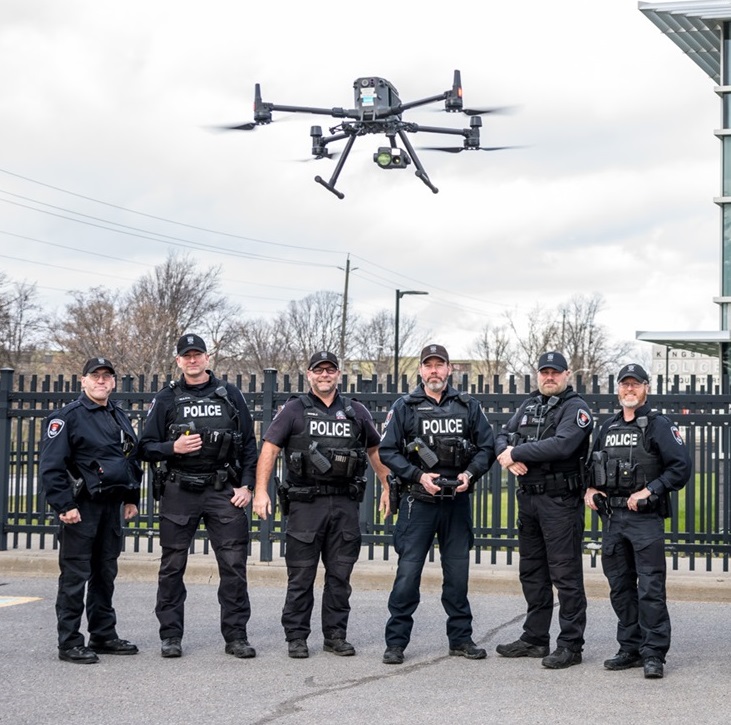
At the moment, many professional drone operations across Canada continue to rely heavily on Chinese-manufactured aircraft. DJI platforms dominate in particular. These systems are now deeply integrated into inspection, mapping, agriculture, cinematography, and public safety. They earned that position because they are capable, reliable, and accessible across a broad range of operational needs.
That operational reality surfaced directly during the recent 2026 Kenneth M. Molson Lecture at the Canada Aviation and Space Museum. During a panel discussion on the future of drone technology in Canada, Lieutenant-Colonel Nicolas Verreault of the Canadian Armed Forces openly acknowledged DJI’s technical leadership. He noted that “their drones are some of the best in the world.”3
The Challenge for Canadian Manufacturers
His comments highlighted one of the central challenges now facing Canada as governments begin reconsidering procurement policies for security-sensitive operations. Replacing existing systems is not simply a matter of choosing another aircraft. Competing at that level requires significant long-term investment, industrial coordination, and the ability to scale manufacturing and research over time.
Verreault also pointed to the massive investment now flowing into drone development internationally. Consequently, he emphasized that Canada would need similar long-term commitment to build competitive domestic capability in this space.
Dr. Margaret Kalacska of McGill University reinforced the practical reality many operators already understand. Referring to the widespread adoption of DJI systems, she explained that organizations often selected those platforms because “we needed them to work at that moment.” Moreover, she added that many smaller Canadian companies simply did not yet have the ability to compete at the same level or scale.4
Together, those perspectives help frame the Ontario announcement in a more practical context. This is not a sudden declaration that existing drone systems are unsafe. Nor does it mean commercial operators need to replace their fleets immediately. Instead, it reflects a growing emphasis on cybersecurity, data management, and operational resilience in government and security-sensitive environments.
For enterprise operators and organizations working with government clients, these conversations are likely to become increasingly important moving forward. Procurement requirements, cybersecurity standards, and data-handling expectations are evolving alongside the technology itself.
For now, treat Ontario’s announcement less as a disruption to the broader Canadian drone community. Rather, it marks the beginning of a larger conversation about procurement, operational security, and long-term Canadian drone capability. The challenge ahead is not simply identifying alternatives. Ultimately, it is determining whether Canada will invest in building an ecosystem that can compete at that level in the years ahead.
Footnotes
- Government of Ontario. “Ontario Restricting Government Use of Chinese-Made Drones.” Ontario Newsroom. https://news.ontario.ca/en/release/1007477/ontario-restricting-government-use-of-chinese-made-drones ↩︎
- Ibid ↩︎
- Canada Aviation and Space Museum. “2026 Kenneth M. Molson Lecture – Drones at work: Real stories, real impact.” Panel discussion featuring Lieutenant-Colonel Nicolas Verreault and Dr. Margaret Kalacska. https://www.youtube.com/watch?v=ld_rwCneSmI ↩︎
- Ibid ↩︎